introduction: what investors need to evaluate
Virella 2 is being searched for its price, rental yield, and real estate ROI Dubai potential. Investors today are less influenced by branding and more focused on data-backed return metrics, especially in large-scale suburban communities.
This analysis positions Virella 2 within Dubai as a capital allocation decision. The objective is to assess whether the project delivers sufficient ROI relative to its pricing, risk profile, and long-term appreciation potential.
market context: villas vs apartments in current cycle
Dubai’s residential market shows a clear divergence between apartments and villas. Apartments dominate rental income Dubai with yields often exceeding 6%, while villa communities typically deliver 4%–5% yields but outperform in appreciation phases.
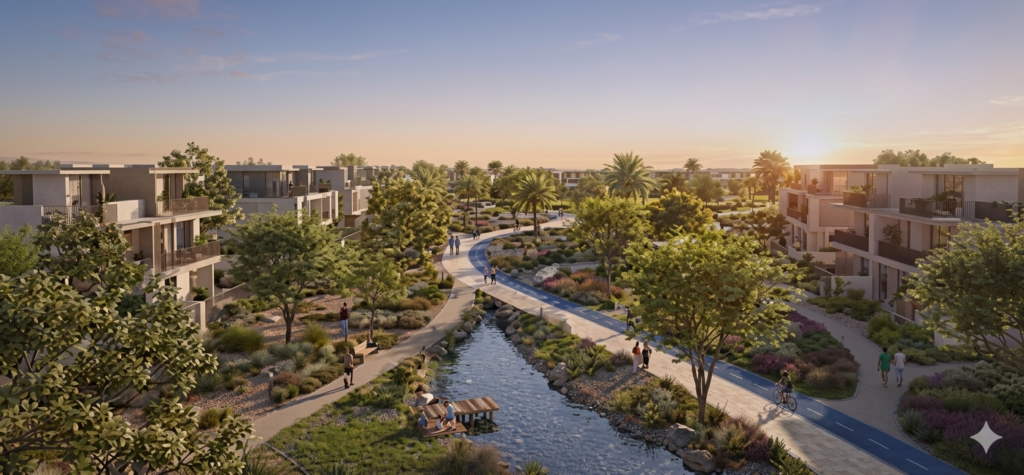
Virella 2, developed by Emaar Properties within The Valley Dubai, falls into the villa/townhouse segment. This categorization matters because it immediately shifts the investment thesis from income generation to long-term capital growth.
Supply expansion in suburban villa communities is ongoing, which introduces both opportunity and absorption risk depending on demand sustainability.
virella 2 price, payment plan and cost structure
Virella 2 price is expected to range between AED 1.9M and AED 3.2M depending on unit type and configuration. Price per sq. ft typically falls between AED 1,100 and AED 1,400, which is competitive relative to other Emaar townhouse launches.
The payment plan is likely structured around 80/20 or 70/30, reducing initial capital outflow but increasing exposure to market cycles during construction.
Service charges in such communities remain relatively low, averaging AED 3 to AED 5 per sq. ft annually. However, total ownership cost increases when factoring landscaping, maintenance, and vacancy buffers.
From a valuation standpoint, Virella 2 is priced within fair market range. It does not offer deep entry discounts but benefits from Emaar’s pricing discipline, which tends to support resale stability.
virella 2 roi and rental yield expectations
Gross rental yield for Virella 2 is expected between 4.5% and 5.5%, based on comparable townhouse communities in Dubai.
After deducting service charges, maintenance, and vacancy adjustments, net ROI typically falls between 3.8% and 4.5%.
This yield is lower than apartment investments but consistent with suburban townhouse assets. The key implication is that return performance depends significantly on capital appreciation rather than rental income alone.
location analysis: demand drivers and connectivity
The Valley Dubai is positioned along Dubai-Al Ain Road, offering connectivity to major economic zones within 25–35 minutes. This travel time is acceptable for end-users but less attractive for tenants seeking proximity to central districts.
Demand in such locations is driven primarily by families seeking affordability and space. This creates stable occupancy but limits rental upside compared to core urban areas.
Compared to locations like Downtown Dubai or Dubai Marina, Virella 2 trades rental yield for entry affordability and future infrastructure-driven appreciation.
real investor scenario: realistic financial breakdown
Consider a townhouse priced at AED 2.4M. Expected annual rental income would range between AED 110,000 and AED 125,000.
After deducting service charges, maintenance, and vacancy allowance, net income typically settles around AED 95,000.
This translates to a net ROI of approximately 4%.
If property prices appreciate at 5% annually, total return approaches 9%, which aligns with long-term Dubai residential averages.
comparing virella 2 with competing options
Compared to apartment investments in JVC, Virella 2 offers lower rental yield but better potential for capital appreciation due to land-linked value.
Against competing townhouse communities like DAMAC Hills 2, pricing is slightly higher but supported by stronger developer credibility and resale liquidity.
Risk-adjusted, Virella 2 sits in the moderate-return, moderate-risk category. It does not maximize yield but reduces downside through brand-backed demand.
who should invest in virella 2
This project is suitable for investors targeting long-term appreciation with stable but moderate rental income.
It is not suitable for investors seeking high cash flow or short-term flipping opportunities.
End-users benefit from livability and space, which indirectly supports resale demand and price stability.
risks and limitations to consider
Supply expansion in suburban communities remains a key risk. If absorption slows, price appreciation may be delayed.
Rental demand is stable but capped due to location distance from central business districts.
Resale liquidity is lower compared to apartments because of higher ticket size and narrower buyer pool.
Market downturns tend to impact suburban assets more due to dependency on end-user demand.
strategic insight: timing and holding strategy
Entry at early launch pricing provides the best margin for appreciation. Late entry reduces upside and increases exposure to market corrections.
A holding period of 5 to 7 years is necessary to capture both rental income and appreciation cycles.
Exit strategy should align with community maturity and infrastructure completion, which typically drives peak pricing.
final verdict: yield vs appreciation classification
Virella 2 qualifies as an appreciation-driven investment with moderate yield support.
It does not compete with high-yield apartment assets but offers long-term capital growth potential backed by Emaar Properties and master community planning.
For investors prioritizing stability and appreciation over immediate income, this project fits as a strategic portfolio allocation.
faqs
- What is the price of Virella 2 in Dubai?
Prices typically range from AED 1.9M to AED 3.2M depending on unit size.
Price per sq. ft falls between AED 1,100 and AED 1,400. - What rental yield can investors expect?
Gross rental yield is around 4.5% to 5.5%.
Net ROI after costs usually ranges between 3.8% and 4.5%. - Is Virella 2 a good investment in 2026?
It is suitable for long-term appreciation-focused investors.
It is less ideal for high rental income strategies. - How does it compare to apartments in Dubai?
Apartments offer higher rental yields above 6%.
Townhouses provide better appreciation potential over time. - What is the payment plan structure?
Typical plans follow 70/30 or 80/20 construction-linked payments.
This reduces upfront capital but extends investment duration. - Is Virella 2 overpriced?
Pricing is aligned with similar Emaar townhouse launches.
It reflects fair market value without deep discounts. - What are the key risks?
Risks include supply expansion and slower appreciation cycles.
Location distance also caps rental growth potential. - What is the ideal holding period?
A holding period of 5 to 7 years is recommended.
This allows full participation in appreciation cycles. - Who should avoid this investment?
Investors seeking high monthly rental income should avoid it.
Short-term traders may not find sufficient returns. - Is this project suitable for end-users?
Yes, it offers space and community-driven living benefits.
This supports long-term demand and resale value.
About The Author