
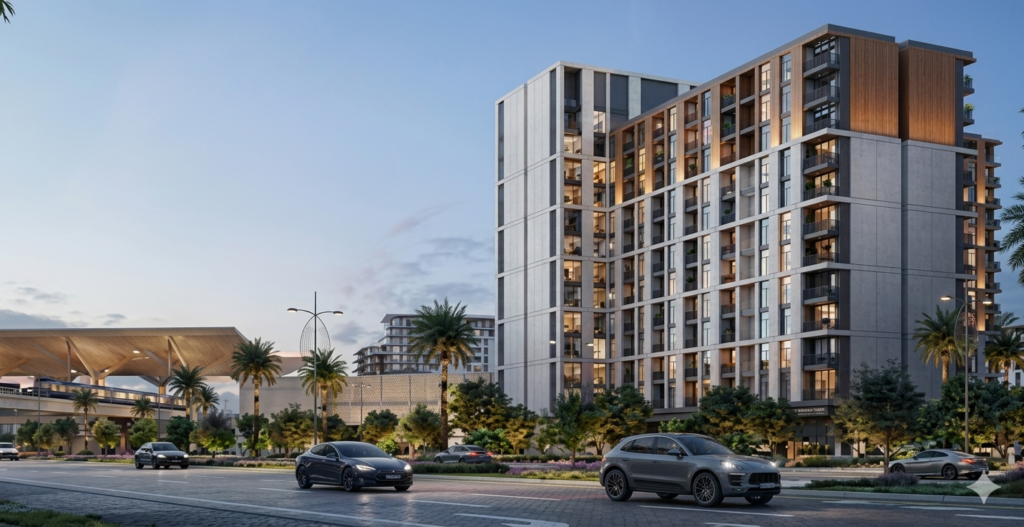
Emaar Terra Woods is being searched for its price positioning, rental yield, and real estate ROI in Dubai. Investors are no longer buying based on brand alone; capital allocation decisions are now driven by yield visibility, exit liquidity, and downside risk.This analysis treats Emaar Terra Woods as an investment asset, not a lifestyle product. The goal is to quantify whether the project justifies capital deployment compared to alternative Dubai real estate opportunities.
market context: where this project fits in dubai’s cycle
Dubai’s residential market remains segmented between high-yield apartments and appreciation-driven villa communities. Apartments in core zones are delivering 6–8% rental yield, while villas typically compress to 4–6% but outperform in capital appreciation cycles.
Emaar Terra Woods, developed by Emaar Properties, sits in the villa-dominated segment. This means investors should expect lower immediate rental income but potential mid-cycle price appreciation driven by end-user demand and limited branded supply.
The key decision factor here is whether you prioritize cash flow or long-term capital growth.
emaar terra woods price, payment plan and cost structure
Emaar Terra Woods pricing is expected to align with premium suburban villa communities in Dubai, typically ranging between AED 1,400 to AED 1,800 per sq. ft depending on unit configuration and plot size.
A standard unit entry price is estimated between AED 3.2M to AED 5.5M. Payment plans in Emaar projects usually follow a 70/30 or 80/20 structure, reducing upfront capital pressure but extending exposure to market cycles.
Service charges for villa communities remain relatively moderate at AED 3 to AED 5 per sq. ft annually, but total holding cost increases due to maintenance and vacancy risk.
From a valuation perspective, this pricing is neither deeply discounted nor speculative. It reflects brand premium plus master community positioning, which limits upside arbitrage but enhances downside protection.
emaar terra woods roi and rental yield reality
Gross rental yields for comparable villa communities in Dubai range between 4% and 5.5%. For Emaar Terra Woods, a realistic assumption sits closer to 4.5% given premium pricing.
After factoring service charges, maintenance, and vacancy, net ROI typically compresses to 3.5%–4.2%.
This is materially lower than apartment investments in areas like Dubai Marina or JVC, where yields exceed 6%. The implication is clear: this project is not a yield-maximization play.
It is positioned as a capital appreciation asset with moderate income support.
location analysis: demand drivers and connectivity
Emaar Terra Woods benefits from Dubai’s expanding suburban master-planned development model. These communities are designed for end-users seeking space, privacy, and integrated infrastructure.
Connectivity to major highways such as Sheikh Mohammed Bin Zayed Road typically ensures access to business districts within 25–35 minutes, which is critical for long-term occupancy demand.
Compared to central locations like Downtown Dubai, the trade-off is lower rental yield but stronger family-driven demand stability.
Infrastructure-led appreciation is the primary driver here, not immediate rental arbitrage.
real investor scenario: actual numbers that matter
Consider a mid-sized villa priced at AED 4 million. Annual rental income realistically ranges between AED 160,000 and AED 180,000.
After deducting service charges, maintenance, and vacancy buffers, net income falls to approximately AED 140,000.
This results in a net ROI of roughly 3.5%.
If property prices appreciate at 5% annually, total return moves closer to 8%–9%. Without appreciation, the investment underperforms relative to high-yield alternatives.
This highlights the dependency on market growth for overall profitability.
comparing emaar terra woods with competing options
Compared to apartment-heavy zones like JVC or Business Bay, Emaar Terra Woods trades yield for brand-backed appreciation potential.
Against competing villa communities such as Arabian Ranches or DAMAC Hills, pricing is slightly higher but supported by Emaar’s stronger resale liquidity and buyer trust.
Risk-adjusted, this project offers lower volatility but also lower short-term returns.
who should actually invest in this project
This investment suits buyers targeting long-term capital appreciation with moderate rental income as a secondary objective.
It is not suitable for investors seeking aggressive cash flow, quick flips, or short holding periods.
End-users planning to occupy the property gain additional utility value, which improves overall return justification.
risks and limitations investors must consider
Supply risk remains a key concern as Dubai continues to launch new villa communities. Oversupply can delay appreciation cycles.
Holding costs are higher compared to apartments, reducing net ROI during low occupancy periods.
Resale liquidity, while better than non-branded projects, is still slower than apartments due to higher ticket size.
Market cycles also disproportionately impact villa pricing during downturns.
strategic insight: timing, holding and exit
Entry timing should align with early or mid-launch phases where pricing gaps exist. Late-stage entry reduces upside potential significantly.
A minimum holding period of 5–7 years is required to fully capture appreciation cycles in villa communities.
Exit strategy should target peak demand phases driven by infrastructure completion and community maturity.
Short-term flipping is not advisable in this asset class.
final verdict: yield vs appreciation positioning
Emaar Terra Woods classifies as an appreciation-driven investment with moderate yield support.
It is not a high-ROI rental asset but offers relatively stable long-term value backed by a strong developer and planned community ecosystem.
Investors allocating capital here should prioritize portfolio diversification rather than income generation.
faqs
- What is the expected price of Emaar Terra Woods in 2026?
Prices are estimated between AED 3.2M and AED 5.5M depending on unit size and location.
Per sq. ft pricing typically ranges from AED 1,400 to AED 1,800. - What rental yield can investors expect?
Gross rental yield is around 4% to 5.5% based on current villa market trends.
Net ROI usually falls between 3.5% and 4.2% after expenses. - Is Emaar Terra Woods good for rental income?
It is not optimized for high rental income compared to apartments.
The project is better suited for appreciation-focused investors. - How does it compare to apartments in Dubai?
Apartments offer higher rental yields, often exceeding 6%.
Villas like Terra Woods offer lower yield but better long-term appreciation. - What is the payment plan structure?
Typical Emaar plans follow 70/30 or 80/20 construction-linked payments.
This reduces upfront capital but increases exposure duration. - Is the project overpriced?
Pricing reflects brand premium and community positioning.
It is fairly valued but not deeply discounted. - What are the main risks?
Oversupply, slower resale, and lower rental yield are key risks.
Market downturns also affect villas more than apartments. - What holding period is recommended?
A minimum of 5–7 years is required to realize appreciation.
Short-term investments may not generate optimal returns. - Who should avoid investing here?
Investors seeking high monthly cash flow should avoid this asset.
Short-term traders may find better opportunities elsewhere. - Is this a good end-user purchase?
Yes, end-users benefit from lifestyle and space advantages.
This improves overall value beyond pure financial returns.
About The Author