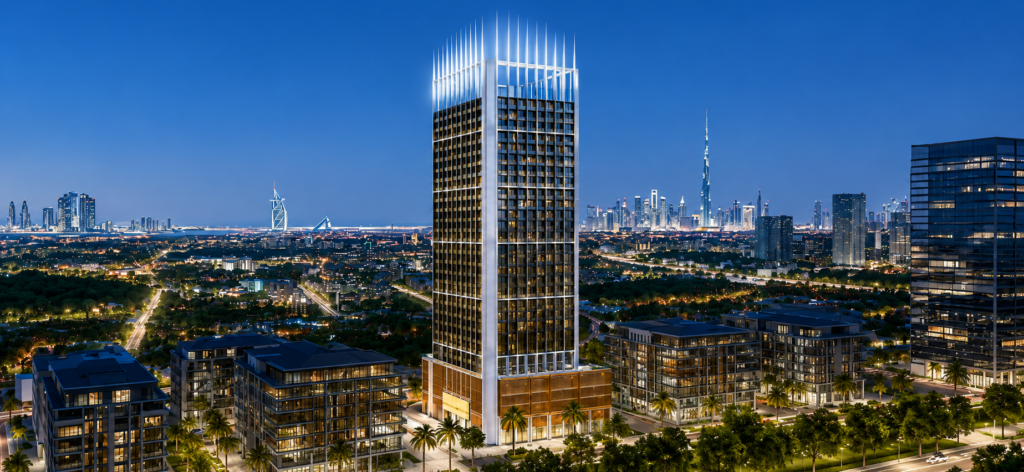
Binghatti Square 3 enters the market during a period when Dubai investors face a difficult allocation decision. Prime districts continue attracting capital, yet rising acquisition costs have compressed yields and reduced appreciation upside. This has increased attention toward emerging communities where pricing remains relatively accessible.
Located within Mohammed Bin Rashid City District 11, Binghatti Square 3 represents a classic early-cycle investment proposition. Investors are not buying established demand. They are buying anticipated demand.
The key question is whether future growth prospects justify today’s entry pricing and construction risk.
How the Local Property Cycle Is Actually Evolving Around Binghatti Square 3
Dubai’s residential market has entered a more selective phase.
Capital appreciation remains positive across many communities, but gains are increasingly concentrated in locations benefiting from infrastructure expansion and population migration rather than broad market momentum.
District 11 falls into this category.
Unlike mature investment hubs where appreciation is becoming harder to achieve, the area still has room for value discovery. New roads, educational facilities, and commercial activity continue supporting long-term demand formation.
For investors, this matters because appreciation tends to occur before a district reaches maturity, not after.
Where Binghatti Square 3 Sits Within the Current Pricing Spectrum
Pricing is often the single most important factor in determining future investment performance.
Based on comparable launches by Binghatti Developers, market expectations place Binghatti Square 3 within the mid-market segment of MBR City. Investors can reasonably expect pricing to remain below many established MBR City developments while still benefiting from the same master-community growth narrative.
This creates a potential pricing inefficiency.
Properties acquired below future neighborhood averages typically generate stronger returns than premium developments purchased at fully valued prices.
The payment plan structure further improves investment flexibility by allowing capital deployment over multiple construction stages rather than requiring full exposure upfront.
Binghatti Square 3 Rental Yield Expectations Versus Market Reality
Many investors searching for a high rental yield property UAE opportunity focus exclusively on headline numbers.
A more realistic assessment requires examining both gross and net returns.
Assuming acquisition pricing between AED 1.1 million and AED 1.3 million for a typical one-bedroom apartment, annual rental income could realistically range between AED 72,000 and AED 88,000 after market stabilization.
That implies gross rental yields of roughly 6% to 7.5%.
After accounting for service charges, vacancy periods, maintenance costs, and leasing expenses, net yields are likely to settle between 5% and 6.2%.
These figures remain attractive compared with many international property markets, although they should not be viewed as extraordinary within Dubai standards.
Why Tenant Demand May Become More Important Than Amenities
Investors frequently overestimate the value of amenities and underestimate the importance of tenant quality.
The strongest rental markets are not necessarily those with the most facilities. They are the markets attracting stable residents with predictable occupancy behavior.
Binghatti Square 3 benefits from proximity to major employment corridors, educational institutions, and transportation networks.
This creates a tenant base consisting primarily of professionals and families rather than transient occupants.
Long-term tenants typically generate more stable cash flow and lower turnover costs, strengthening investment performance over time.
A Realistic Investor Return Model
Consider an investor purchasing a one-bedroom apartment at AED 1.2 million.
Assume rental income stabilizes at AED 78,000 annually following handover.
This produces a gross rental yield of approximately 6.5%.
If District 11 experiences annual appreciation between 4% and 6%, total annualized returns may fall within the 9% to 12% range before financing costs.
A more conservative scenario should also be examined.
If supply growth exceeds demand and appreciation slows to 2% annually, total returns could decline toward 6% to 8%.
The investment outcome therefore depends more on future district evolution than short-term rental performance.
How Binghatti Square 3 Compares With Competing Communities
Compared with Jumeirah Village Circle, Binghatti Square 3 offers exposure to an earlier growth cycle but a less established rental ecosystem.
Compared with Dubai Silicon Oasis, the project benefits from stronger long-term positioning within the broader MBR City vision, although Silicon Oasis currently offers deeper transaction history.
Compared with Business Bay, investors gain a lower entry price and potentially greater appreciation upside while sacrificing immediate liquidity.
This comparison highlights a critical reality.
Binghatti Square 3 is primarily an appreciation-driven investment rather than a cash-flow-focused acquisition.
Which Investors Are Most Likely to Benefit?
The project is best suited to investors with holding periods exceeding five years.
Buyers seeking immediate rental certainty may find completed assets in mature communities more attractive.
Investors pursuing off-plan investment Dubai opportunities with stronger growth potential could find the risk-reward balance more appealing.
End-users also benefit because future neighborhood improvements can enhance both lifestyle utility and long-term asset value.
Risks Investors Should Not Ignore
Supply remains the most significant concern.
Dubai continues delivering substantial residential inventory across multiple districts, and emerging communities are particularly sensitive to oversupply.
Liquidity represents another consideration.
Properties located within developing districts typically require longer selling periods than assets in Downtown Dubai or Dubai Marina.
Construction timing risk should also be incorporated into any underwriting model. Delays can affect both capital appreciation assumptions and expected rental commencement dates.
Ignoring these risks leads to unrealistic ROI projections.
The Strategic Insight Most Buyers Miss
Many investors evaluate projects individually.
Institutional capital evaluates districts.
The stronger investment case for Binghatti Square 3 is not the building itself. It is the broader transformation of District 11 into a more mature residential and commercial environment.
Historically, the highest-performing real estate investments have often been linked to district evolution rather than individual project specifications.
That perspective changes how investors should assess risk.
Final Verdict
Binghatti Square 3 presents a credible investment opportunity for buyers seeking long-term appreciation within an expanding MBR City corridor.
The project does not appear positioned to deliver the highest rental yields in Dubai. Its strongest attribute is future value creation through district maturation and infrastructure-led demand growth.
Investors prioritizing rental income may find stronger opportunities elsewhere.
Investors seeking real estate ROI Dubai through strategic early positioning may view Binghatti Square 3 more favorably.
At competitive launch pricing, the project offers a reasonable balance between risk and upside. At pricing levels approaching mature communities, the investment advantage becomes less compelling.
Frequently Asked Questions
Can Binghatti Square 3 outperform established Dubai communities over the next decade?
Its strongest potential advantage comes from future district growth, which may generate higher appreciation than some mature neighborhoods.
What rental yield range should investors realistically underwrite?
Most conservative investment models should assume gross rental yields between 6% and 7.5% after stabilization.
Is Binghatti Square 3 suitable for first-time Dubai property investors?
It can suit first-time investors comfortable with off-plan exposure and medium-term holding strategies.
How important is the payment plan to overall investment performance?
Flexible payment structures can improve capital efficiency and reduce immediate funding requirements during construction.
Will future supply negatively affect returns?
New inventory remains the largest threat to both rental growth and resale pricing across emerging districts.
Is appreciation or rental income the stronger investment angle?
Capital appreciation appears more compelling than rental cash flow based on current market positioning.
How does the project compare with JVC investments?
JVC provides stronger rental depth today, while Binghatti Square 3 may offer greater appreciation potential if district growth accelerates.
What type of tenant demand is expected after handover?
Professionals and families seeking connectivity and affordability are likely to represent the core tenant segment.
Does location support long-term resale demand?
The broader MBR City growth narrative supports future buyer demand, provided infrastructure development continues as expected.
What is the most important factor investors should monitor?
Launch pricing relative to comparable MBR City projects will likely determine whether future returns remain attractive.
About The Author