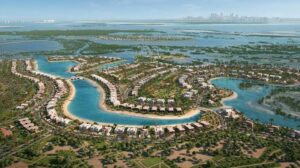
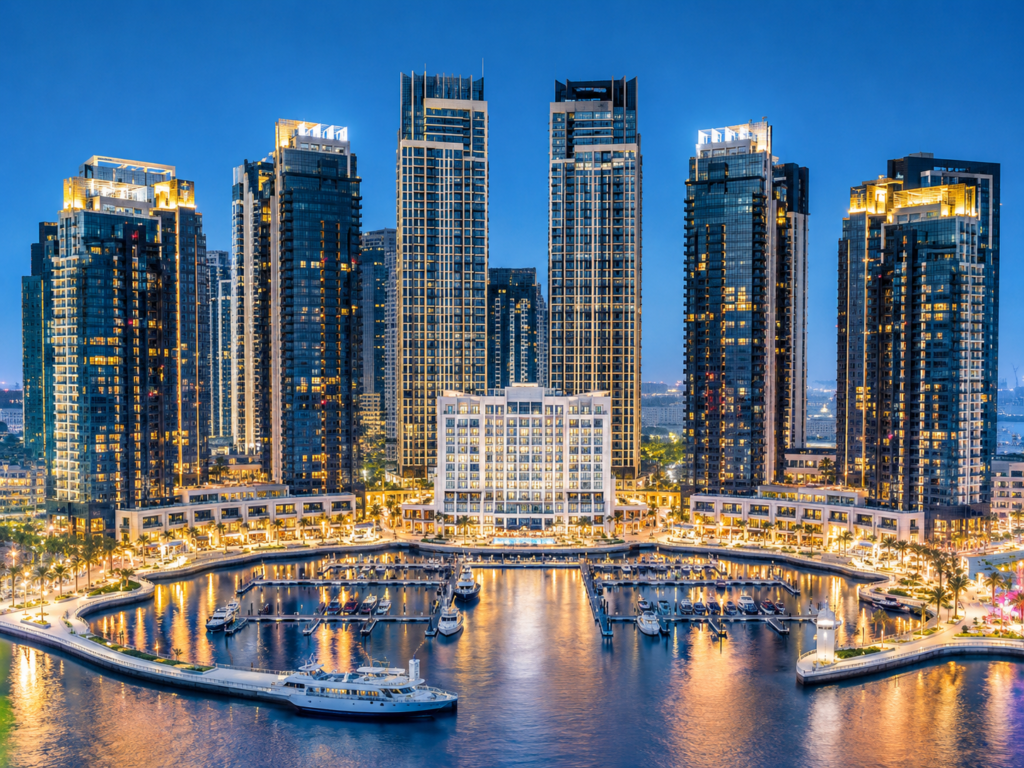
Valia Tower is a newly launched residential project by Emaar Properties within Dubai Creek Harbour, one of the most strategically planned waterfront districts in Dubai. The project comprises approximately 491 apartments within a high-rise tower positioned inside a master-planned community designed for long-term population growth and infrastructure expansion.
For investors evaluating the best property investment in Dubai, the central question is not whether the project looks attractive. The real question is whether entry pricing, rental demand, and future resale liquidity justify the capital commitment.
How the Dubai Creek Harbour Investment Cycle Is Evolving
Dubai Creek Harbour has moved beyond its early speculative phase and is now entering a maturity stage where rental demand increasingly supports valuations. That distinction matters because projects relying solely on appreciation tend to become vulnerable during market slowdowns.
The community benefits from proximity to Downtown Dubai, Dubai International Airport, Business Bay, and major transport corridors. As infrastructure continues to mature, demand is gradually shifting from investor-led purchases toward actual occupancy.
A notable investor observation is that Dubai Creek Harbour still trades at a discount to many prime waterfront districts despite offering comparable urban planning standards. That pricing gap remains one of the area’s strongest investment arguments.
Where Valia Tower Sits on the Pricing Curve
At the time of launch, pricing remains largely positioned as a premium waterfront product under the Emaar brand. While final unit prices vary by configuration, comparable Dubai Creek Harbour inventory currently trades within premium mid-market to upper-mid-market pricing bands.
Investors should focus less on headline price and more on price per square foot relative to competing waterfront communities. If Valia Tower enters the market below future launch phases within the same masterplan, early buyers may capture appreciation before handover.
The staged payment structure further improves capital efficiency because investors can deploy capital progressively rather than committing the entire acquisition cost upfront.
Valia Tower Rental Yield Potential Versus Real Costs
Rental yield is likely to be one of the stronger components of the investment case. Market expectations for Dubai Creek Harbour apartments generally support gross yields in the 6%–8% range, while optimistic projections can exceed this depending on unit type and market conditions. Some project marketing material suggests higher potential returns, though investors should model more conservative assumptions.
For example, a property acquired at AED 1.8 million generating AED 120,000 to AED 140,000 annually in rent would produce a gross rental yield between 6.7% and 7.8%.
After service charges, vacancy allowance, maintenance reserves, and leasing costs, a realistic net yield expectation may settle between 5.2% and 6.5%.
That places Valia Tower within the range often sought by investors targeting high rental yield property UAE opportunities without assuming excessive risk.
Why Tenant Demand May Remain Durable at Valia Tower
Tenant quality matters more than tenant quantity. Communities dominated by transient demand often experience volatile occupancy patterns.
Dubai Creek Harbour attracts professionals working in Downtown Dubai, Business Bay, DIFC, and airport-related sectors. This creates a relatively stable tenant profile with stronger income levels than many peripheral communities.
The waterfront setting, proximity to employment centers, and growing retail infrastructure support occupancy resilience. These factors improve pricing power during lease renewals and reduce vacancy risk compared with less established off-plan investment Dubai locations.
A Practical Investor Scenario Using Conservative Assumptions
Assume an investor acquires a one-bedroom apartment for AED 1.75 million.
Using annual rental income of AED 125,000, gross yield reaches approximately 7.1%.
After accounting for service charges, maintenance, and vacancy provisions, net income may fall to roughly AED 100,000 annually.
If property values appreciate at a conservative 4% to 6% annually over a five-year horizon, total annualized returns could approach 9% to 12%.
In a stronger market environment, appreciation may become the dominant return driver. In a weaker market cycle, rental income would likely carry a greater share of total returns.
Compared With Alternative Dubai Investment Communities
Compared with Downtown Dubai, Valia Tower offers a lower entry price and potentially stronger rental yield profile.
Comparison with Dubai Marina, it offers newer infrastructure and greater masterplan-driven growth potential, though Marina currently provides deeper resale liquidity.
Compared to emerging locations such as Dubai South, Valia Tower benefits from a more established demand base but may deliver lower appreciation spikes because a portion of future growth is already reflected in pricing.
The project therefore sits between pure growth investments and pure income investments, creating a balanced risk-adjusted return profile.
Which Investor Profile Fits Valia Tower Best
Valia Tower appears most suitable for investors seeking a combination of rental income Dubai exposure and moderate capital appreciation.
Long-term investors with holding periods exceeding five years may benefit the most. The project is less attractive for short-term speculators seeking rapid flips because market pricing already reflects the strength of the Emaar brand and waterfront location.
End-users also benefit from the location’s improving infrastructure, which supports future resale depth.
Risks Investors Should Not Ignore
The strongest risk is supply pressure. Dubai continues to deliver substantial residential inventory, and future launches within Dubai Creek Harbour may compete directly with existing stock.
Liquidity risk is another consideration. Waterfront communities generally attract buyers, but resale velocity can slow during broader market corrections.
There is also execution risk. While Emaar maintains a strong delivery record, off-plan investments always carry timing uncertainty associated with construction and market cycles.
Investors expecting immediate appreciation should recognize that future returns may be lower than those achieved during Dubai’s strongest recent growth phases.
The Strategic Signal Hidden Beneath the Marketing
Many investors focus on views, architecture, and amenities. The more important factor is land scarcity inside mature waterfront masterplans.
Valia Tower benefits from being positioned within a finite waterfront district where future supply is naturally constrained by geography and masterplan boundaries.
That characteristic improves long-term pricing resilience. It does not eliminate risk, but it creates a stronger foundation for capital preservation compared with projects in areas where land supply remains abundant.
Final Verdict: Is Valia Tower Worth Investing In?
Valia Tower presents a balanced investment proposition rather than a speculative opportunity.
The strongest investment case rests on three factors: the credibility of Emaar, the long-term growth trajectory of Dubai Creek Harbour, and the potential for stable rental income supported by professional tenant demand.
Investors seeking aggressive short-term gains may find higher upside elsewhere. Investors prioritizing real estate ROI Dubai through a combination of income generation, liquidity, and capital preservation are likely to view Valia Tower more favorably.
From a risk-adjusted perspective, the project fits best within a long-term portfolio strategy where consistent returns matter more than speculative appreciation.
FAQs
• What rental yield can investors realistically expect from Valia Tower?
A realistic net rental yield range is approximately 5.2% to 6.5%, depending on acquisition price, occupancy rates, and ongoing ownership expenses.
• Is Valia Tower better for cash flow or capital appreciation?
The project offers a balanced profile, though long-term appreciation and rental income are expected to contribute relatively equally to total returns.
• Does Dubai Creek Harbour support strong tenant demand?
The community attracts professionals and families seeking proximity to business districts, supporting consistent occupancy and relatively stable rental demand.
• How does Valia Tower compare with Downtown Dubai investments?
Valia Tower generally offers lower entry pricing and potentially stronger yields, while Downtown Dubai benefits from deeper resale liquidity.
• What is the biggest risk facing investors?
Future residential supply across Dubai remains the primary risk, as increased inventory can limit rent growth and appreciation rates.
• Can foreign investors purchase units in Valia Tower?
Yes, Dubai’s freehold framework allows eligible international investors to acquire residential property in designated ownership zones.
• Is the payment plan attractive for investors?
Construction-linked payment schedules improve cash-flow management and reduce the need for immediate full-capital deployment.
• How strong is the developer behind the project?
Emaar maintains one of the strongest delivery and brand reputation records in the UAE residential property sector.
• Will future infrastructure affect property values?
Improved transportation connectivity and community maturation typically strengthen long-term demand and support property valuations.
• Is Valia Tower suitable for first-time Dubai investors?
Investors seeking moderate risk, established developer credibility, and long-term wealth preservation may find it a practical entry point into Dubai real estate.
About The Author